 PPTF
PPTFDrawdown calculator: static against trailing
The drawdown calculator shows both thresholds at once, static and trailing. The difference between them is small in words and decisive in numbers: trailing turns what you earned into a new starting point.
Calculation
The threshold travels behind the peak and on the way down stays where it got to: which is why an account is closed while still in profit against the start.
Two rules, one figure of “10%”
In the terms both drawdowns are often written the same way — “maximum loss 10%”. They are measured from different things, and that changes everything.
| Static | Trailing | |
|---|---|---|
| Reference base | The account's starting balance | The highest equity reached |
| Where the threshold moves | Nowhere, it stays put | Only up, behind the peak |
| What profit does | Increases the cushion to the threshold | Lifts the threshold, the cushion does not grow |
| Can an account be closed in profit | No | Yes |
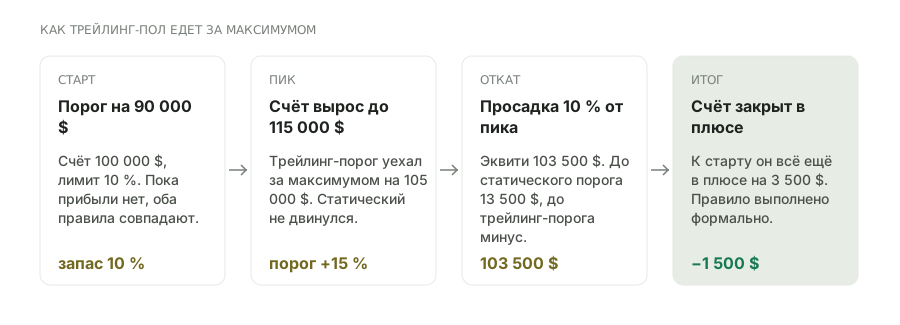
The main consequence in numbers. A $100,000 account, a maximum limit of 10%, a peak at 15% profit — $115,000. With a static limit the threshold still stands at $90,000, and what you earned is a cushion. With trailing the threshold has travelled to $105,000. A drawdown of 10% from the peak gives equity of $103,500: the account is closed, though it is $3,500 in profit against the start. In “trailing stops at the starting balance” mode the same account survives — the threshold froze at $100,000.
Where trailing stops
Fully free trailing is rare: at some programmes the threshold travels behind the peak until it catches up with the starting balance, and then freezes. That is an important distinction, because it decides whether a cushion builds up after the first few per cent of profit. Both modes are in the calculator — the switch under the sliders.
What to look for in the rules
- The words trailing and static
- The first means a threshold from the peak, the second from the start. If it says only “max loss 10%”, the base is undefined, and that is a reason to ask support in writing, before paying.
- How high the trailing goes
- A wording such as “trails up to your initial balance” means the second mode: after that point the threshold freezes and a cushion starts to build.
- Whether the threshold is counted on balance or on equity
- If on equity, the peak is recorded on floating profit: an open position that was in profit has already lifted the threshold.
How to read the result
What the calculation does not account for
If the firm records the maximum on equity, the threshold is lifted even by an open position that was in profit and then came back to zero.
check the baseAt some programmes the peak is taken at the close of the day, at others in real time. A difference of one day changes the threshold by that day's whole profit.
ask in writingBoth work at once. An account can be lost on the daily limit while there is plenty of cushion to the trailing threshold.
count them togetherWhen the account grows under a scaling plan, the threshold is recomputed too. The rules for that are written separately from the drawdown rules.
read both sectionsHow it is calculated
Four values, and the whole difference between the two types of limit sits in one line — in what the threshold is measured from.
| Value | Formula | In the example |
|---|---|---|
| Account peak | account × (1 + growth to the peak) | $115,000 |
| Current equity | peak × (1 − fall from the peak) | $103,500 |
| A static threshold | account × (1 − maximum limit) | $90,000 |
| Trailing threshold | peak − account × maximum limit | $105,000 |
| Cushion to the threshold | equity − threshold | −$1,500 and $13,500 |
In the example the account is $100,000, the limit 10%, growth to the peak 15%, the fall from the peak 10%. The static threshold has not moved at all, while the trailing one has risen by $5,000 along with the peak — and those five thousand were enough for an account with $3,500 of profit to end up closed.
The main trap in the formula. The trailing threshold is counted from the peak, not from current equity, and it does not go back. So the higher you have taken the account, the less cushion you have in money for a pullback — at the very same “10%” in the rules.
Frequently asked questions
What is trailing drawdown in plain words?
It is a drawdown threshold that moves behind the highest point your account has reached. Earn, and the threshold rises by the same amount. The distance from current equity to the threshold does not grow with profit, so the cushion is always the same.
Why is an account closed while it is in profit?
Because the trailing threshold is counted from the peak rather than from the start. That is possible only when the profit at the peak exceeded the maximum limit: with a 10% limit and a 15% peak, a drawdown from the peak of between 8.7% and 13% leaves the account in profit against the start and already below the trailing threshold. With an 8% peak it cannot happen — the threshold has not yet risen above the starting balance.
Which drawdown is more dangerous for a strategy with rare large trades?
The trailing one. A single large winning trade sharply lifts the peak and the threshold with it, and the very next run of stops hits it. With a static drawdown the same trade would have created a cushion.
Does the calculator allow for the daily limit?
No, it is about maximum drawdown. The daily limit is counted per day and is covered separately — in daily drawdown and in the losing-streak simulator.
Which mode should I use if the rules do not state the type of threshold?
Work on the worst case — free trailing — and see whether the strategy passes. If it passes only with a static one, the firm is not for you until you have a clarification in writing. How to read the wordings of the rules is covered in maximum drawdown.
How do I allow for the peak being recorded on equity?
Put into “profit at the peak” not the result on closed trades but the highest equity reached — including floating profit that later came back to zero. The threshold is counted from that too.
When does trailing stop moving?
At some programmes, when the threshold catches up with the starting balance; after that it freezes and profit starts working as a cushion. At others it never stops. In the calculator it is a switch, because both variants occur.
How do I work out the cushion straight after a payout?
Set the profit at the peak to zero: after the balance is reset to its original size the trailing threshold returns to where it started from, and the cushion equals the full limit. After that it shrinks again with every new peak.
Which type of drawdown suits position trading better?
The static one. A position trade lives a long time and passes through pullbacks, while trailing records the peak along the way and turns every pullback into a spend of the limit. For scalping the difference is smaller: there a position does not have time to create a peak.
Can the same arithmetic be used if the limit is set in money?
Yes. Enter the limit as a percentage of the account size: $10,000 on a $100,000 account is the same 10%. The arithmetic of the thresholds does not depend on how it is written.
Read next
