 PPTF
PPTFProp firm payout calculator, after the split
The prop firm payout calculator shows the whole chain of deductions: from the trading result to the money on the card. The shop-window split percentage is only one of three deductions, and not the largest.
Calculation
| Step | Amount |
|---|---|
| Trading result | — |
| Trading costs | — |
| Profit after costs — the split base | — |
| The firm's share | — |
| Your share | — |
| Tax on your share | — |
| On the card | — |
Three deductions and three different bases
The order matters more than the percentages. Each deduction is taken from what is left after the previous one, so the total cannot be had by simply multiplying the percentages.
- Trading costs — from turnover
- Commission and spread depend on the number of lots, not on the profit. A scalping strategy with high turnover loses more here than a position strategy with the same profit.
- The firm's share — from profit after costs
- That is exactly why an identical “90% to the trader” at two firms produces different money: if one counts from the trading result and the other from profit after costs, the difference equals the split percentage of all the costs.
- Tax — from your share
- It is counted after the split. The rate depends on residency, the bracket and how the payout is documented — the details are on the page about taxes and the status of payouts.
A practical conclusion follows: programmes should be compared by the last line — the share of the trading result that reached the card. It takes in the percentage, the base and the turnover all at once.
What the calculator counts honestly and what it does not
The split divides profit but not loss. If the base after costs turns out negative, your share is zero and the whole minus reduces your cushion up to the drawdown limit. The calculator says so outright rather than printing a cheerful zero: a loss is shown as a minus.
Three of the four values in the calculation are ones you set yourself, and that is not a flaw: there is no single correct value for them. Turnover depends on the strategy, the tax rate on residency and the bracket, the split base on the particular firm. More on that in the payout cycle and on the page about taxes.
How to read the result
Look at the second line of the output rather than the first. The amount on the card is about one particular cycle, while the share of the result that reached the card is about the programme itself: it can be compared between firms and against your own previous payout.
A separate case is when the split base has gone negative: the calculator shows a zero share and a negative base. That is not an input error but a normal outcome with high turnover and small profit, and it means there will be no payout for the cycle at all.
How it is calculated
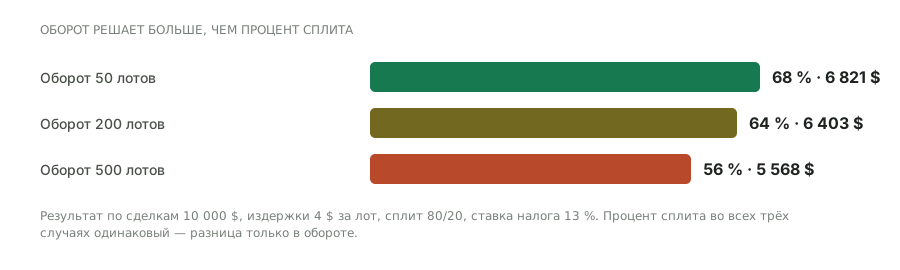
A chain of five steps, and each one is counted from the result of the previous. That is exactly why the percentages cannot be multiplied: each has its own base.
| Step | Formula | In the example |
|---|---|---|
| Costs on turnover | lots × costs per lot | $800 |
| Split base | trading result − costs | $9,200 |
| Your share | split base × split percentage | $7,360 |
| Tax | your share × rate | $957 |
| On the card | your share − tax | $6,403 |
| Share of the result that reached the card | on the card ÷ trading result | 64 % |
In the example the result is $10,000, turnover 200 lots, costs $4 per lot, the split 80/20, the rate 13%. The shop-window 80% turns into 64% — and exactly half of the loss comes not from tax but from turnover.
Where people get it wrong most often. In the split base. If the firm counts your share from the trading result rather than from profit after costs, set the costs to zero and subtract them from your share yourself — the total will be different, and the difference equals the split percentage of all the costs.
Frequently asked questions
What share of the result usually reaches the card?
There is no single figure: it depends on turnover, the split base and the tax rate. In the model example with turnover of 200 lots, costs of $4 per lot, an 80/20 split and a rate of 13%, 64% of the trading result arrives. Put in your own numbers — the order of subtraction will not change.
Why are costs deducted before the split rather than after?
Because that is how most programmes work: the split base is declared to be the account's profit, and commission and spread reduce it before the share is worked out. If your firm uses a different base, set the costs to zero and subtract them from the result by hand — the calculator will show the second variant.
What if turnover is high and profit small?
Then the split base goes negative and there is no payout. That is a typical situation for high-frequency strategies on instruments with a wide spread: the trades show a profit, and after costs they do not.
Where do I find my costs per lot?
In the account specification: the commission per lot is stated outright, and the spread is taken as an average for your instrument and trading hours. Swap is added for holding overnight. The sum of all three is the figure to put into the calculation.
Is the split counted before tax or after?
Before. First the firm divides the profit in the set proportion, and only then is tax paid on your share. The order is fixed and it changes the total: tax on the whole profit would give a different sum.
Which tax rate should I put in?
The one that applies to your case: it depends on your tax residency, the bracket and how the payout is documented. The 13% in the example is an example, not a recommendation. We do not give tax advice: the questions worth asking are set out on the page about taxes.
Is the payment provider's fee included?
No, it is not in the calculation. Some firms transfer the payout with nothing withheld, others pass the transfer fee to the trader. If your programme is the second case, subtract it from the bottom line separately.
Why does the share of the result matter more than the split percentage?
Because the percentage is counted from profit after costs, while the share of the result is counted from what the trades earned. Two programmes with the same 90% split pay different money if one uses the result as its base and the other profit after commission.
What part of the costs can be cut without touching the strategy itself?
Sometimes: switch to an instrument with a tighter spread, move trading into the liquid hours, stop holding positions overnight. But if the strategy lives on high turnover, costs are a built-in property of it, and that has to be taken into account when choosing a firm.
Why are the threshold and the payout cycle not in the calculation?
Because they do not affect the arithmetic of the amount, only when you get it. Below the threshold a request is not accepted, and what you earned goes on sitting on the account under the same drawdown limits — that is, it can be lost before the transfer. That is a separate risk, and it is covered in the payout cycle.
Read next
