 PPTF
PPTFProp trading: training, work and vacancies
Prop trading training is most often sold not by a firm but by people who earn from affiliate referrals. We work out how prop trading work in an office team differs from an online programme, whether prop trading vacancies exist and what is meant by the word internship.
Two worlds under one word
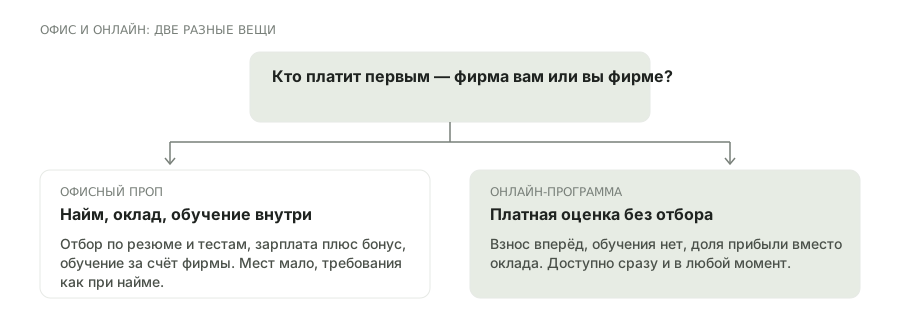
The difference decides everything else: who pays first. In office prop the firm pays you a salary; in an online programme you pay the firm for an evaluation. Training, a career and the very idea of a vacancy exist only in the first.
| Office prop | Online programme | |
|---|---|---|
| Who pays first | The firm — a salary | You — a fee for an attempt |
| Is there a selection process | Yes: a CV, tests, an interview | No: it is available to buy at once |
| Training | In-house, at the firm's expense | No, and none is implied |
| A mentor | Usually yes | No |
| What happens on failure | Dismissal | Loss of the fee |
| Availability | A handful of seats | Round the clock and to anyone |
Prop trading vacancies: where they exist
Real vacancies exist, but not where people usually look for them. An online programme will not hire a trader: its product is an evaluation, not a job. Look at companies that trade their own capital.
A practical sign: in a real vacancy the money moves towards you. Any scheme where you pay first is a purchase, and it should be judged as a purchase.
How to start in prop trading if that is your choice
The order in which the steps make sense. The first two require no money, and skipping them is the most expensive thing you can do.
Two hundred trades at least: without a win rate and an average R there is nothing to compute the probability of passing from, and any decision will be a bet.
freeThe size allowed by the firm's limits at your stop. If it does not suit the strategy, the firm is not for you — and that is established before paying.
freeNot the price of the challenge but the expected spend including resets. At a probability of around 10% that is five and a half times the shop-window price.
before buyingThe first attempt is a test of the engine, the spread and your own discipline under someone else's rules, not a run at profit. A small account is cheaper for that.
the first purchaseFrequently asked questions
Do prop firms provide training?
Online programmes do not: their product is an evaluation, not preparation. Training exists in office prop, where you have been hired, and in the odd “course plus account” programme, which is worth judging as a purchase.
Do prop trading vacancies exist?
They do, but at companies trading their own capital: desk teams at brokers and funds. An online programme will not hire a trader. The practical sign of a real vacancy is that the money moves towards you, not away from you.
What is an internship in prop trading?
In office prop, a probationary period with training and a mentor. In the online model the word is sometimes used for a challenge, which is misleading: an internship implies being paid rather than paying.
How does a beginner start in prop trading?
The first two steps cost nothing: gather two hundred trades of your own statistics and work out whether your size fits the firm's limits. Only then the cost of passing and a minimum account to test the terms.
Do you need a course to pass a challenge?
A course does not pass a challenge — a strategy with a positive edge and the right size does. If a course gives you statistics and an understanding of risk, it is useful; if it promises passing, it is selling something it does not own.
Is it worth paying for a mentor?
That is a separate service, and it should be judged by a verifiable result: does the mentor have statistics of their own and are they willing to show them. A connection to a prop firm has nothing to do with it.
Can you get a job at a prop firm after passing a challenge?
Usually not: there is no career bridge between an online programme and an office team. Statistics from a funded account sometimes help at hiring, but office teams run their own selection and look at their own sample.
Is a degree required for office prop?
For quant and junior trader positions, often yes — in mathematics or a technical subject. For discretionary trading, statistics and passing the tests decide, but the competition there is stiffer.
Is there any point in free contests as training?
As training in discipline, doubtful: a contest format rewards maximum risk while a challenge rewards the opposite. Habits built in a contest tend to get in the way in a challenge.
How long does it take to prepare?
As long as it takes to accumulate two hundred trades at your trading tempo. For an intraday strategy that is months, for a position one longer. It cannot be hurried: the point of the sample is that it is real.
Read next
