 PPTF
PPTFA prop firm scaling plan and account growth
A prop firm scaling plan is a rule for growing the account on results. We work out how scaling a prop trader's account works, what increases with it, what stays the same and why the second matters more than the first.
What a scaling plan is and when it kicks in
A scaling plan is a pre-described increase in account size on conditions being met. The conditions are almost always twofold: results over several cycles and an absence of breaches over the same period. Results alone are usually not enough.
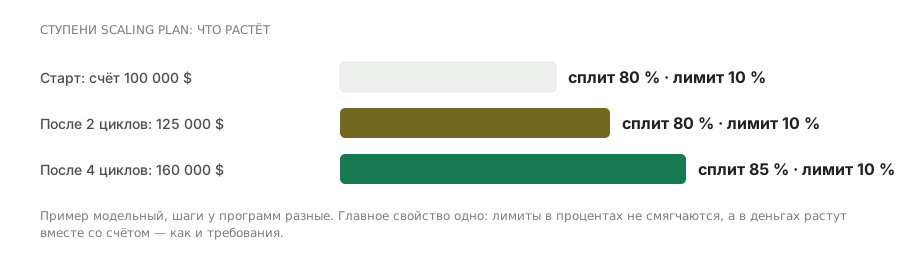
The key property that changes the arithmetic: drawdown limits in per cent are not softened. The account grows, the limit in money grows with it, and in per cent it stays the same. So the requirement on your strategy does not change — only the scale does.
| Step | Account size | The split | Drawdown limit |
|---|---|---|---|
| Start | $100,000 | 80 % | 10 % |
| After 2 cycles | $125,000 | 80 % | 10 % |
| After 4 cycles | $160,000 | 85 % | 10 % |
| After 6 cycles | $200,000 | 85 % | 10 % |
The example is a model: the steps, the number of cycles and the conditions differ between programmes. The only constant is the third column — the percentage limit. That is exactly why a scaling plan does not make passing easier: it makes the same requirements more expensive in money.
Scaling a prop trader's account: what grows and what does not
Hence a non-obvious consequence: a scaling plan increases not only the expected payout but the sum sitting at risk between payouts. On a large account payout frequency matters more than it did on a starting one.
What to check in the scaling plan terms
The programme looks like a bonus, but it has conditions, and some of them restrict more than the growth itself helps.
As the account grows the threshold is recomputed. For trailing programmes that means the cushion built up by profit is wiped out at a step.
always checkSome programmes require a payout request every cycle, or the step does not count. Accumulating profit and getting growth for it will not work.
changes the tacticsA return to the starting step, or a total loss of progress. The second makes risk on a large account incomparably more expensive.
the main questionAt some programmes a step has to be confirmed by results, or the account returns to its previous size.
less commonFrequently asked questions
What is a prop firm scaling plan?
A rule for growing the account size on results: when the conditions are met over several cycles, the account is increased by a set step. Sometimes the trader's share under the split grows with the size.
Are the limits softened when the account is scaled?
No, in per cent they stay the same. In money the limit grows with the account, so the requirement on the strategy does not change — only the scale of the consequences does.
What does it take to reach the next step?
Usually two conditions at once: results over several cycles and an absence of breaches over the same period. Results alone are almost never enough.
Does the split grow with the account?
At some programmes yes, at others it stays at the starting level. A difference of 5 pp is worth working out on a large account: it can give more than the size step itself.
What happens to the progress if the account is lost?
Either a return to the starting step or a total loss of progress — it depends on the programme. That is the main question to put to the terms: it decides how much more expensive risk becomes on a large account.
Is the drawdown threshold recomputed at a step?
Yes, along with the account size. For trailing programmes that means the accumulated cushion is wiped out and the room is minimal again.
Do I have to withdraw profit between steps?
At some programmes yes: without a payout request the cycle does not count. Accumulating profit on the account and being rewarded with growth for it will not work.
Can I decline growth and stay on the current account?
Usually yes, growth is not compulsory. It makes sense if the strategy is sensitive to position size: on a large account the same percentage of risk means a size the market may not absorb without slippage.
Does instant funding have a scaling plan?
Often it does, and there it matters more: the starting split at instant is usually lower, and steps are the only way to raise it. The conditions, meanwhile, are sometimes tougher than for those who passed an evaluation.
Is a firm worth choosing for its scaling plan?
Only after checking the limits and the payout terms. A growth programme works over many cycles, and you have to get there first — which is decided by drawdown and the probability of passing, not by future steps.
Read next
