 PPTF
PPTFRisk disclosure
A risk disclosure is not a formal caveat but a list of what exactly is lost and in what circumstances. We work through four kinds of loss, of which only the first is capped and predictable, and we name the risks we do not undertake to quantify.
Four kinds of loss
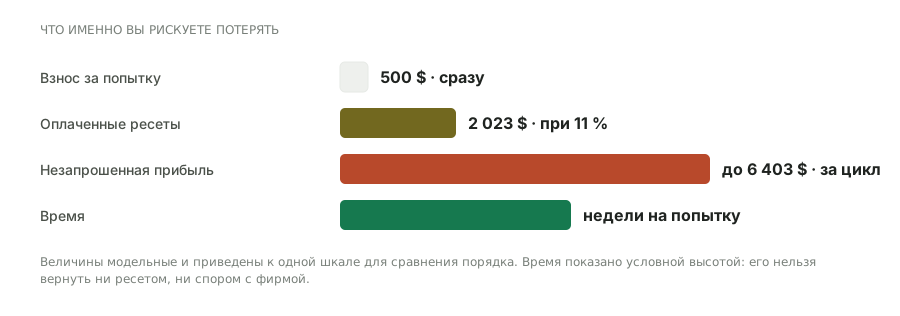
They differ not in size but in how predictable they are. The first is known in advance, the fourth cannot be recovered at all.
| What is lost | When | Predictability |
|---|---|---|
| The fee for an attempt | On a breached limit or a breach of a ban | Complete: the amount is known before you pay |
| The resets paid | With every failed attempt | Calculable: it depends on the probability of passing |
| Unrequested profit | On a breached limit on a funded account | Depends on the payout frequency |
| Time | Weeks per attempt | Recovered by neither a reset nor a dispute |
The main thing to understand about the first risk. Losing the fee on a breached limit is an outcome the rules provide for, not a malfunction and not a deception. The model is built so that most attempts end exactly that way. Plan your participation on the basis that the fee will be lost rather than that it will come back.
What amplifies each risk
What we do not undertake to quantify
Three risks exist, but we have no quantitative estimate for them — and we will not pass a guess off as an estimate.
Risks with no quantitative estimate
- The firm failing to meet its obligations
- A refused payout with the rules observed, terms changed retroactively, the firm ceasing to operate. There are no industry statistics; it is reduced indirectly by checking the terms before paying.
- Legal and tax consequences
- We are not lawyers or tax advisers. We lay out what the question consists of and what to ask a professional, but we are not responsible for the answer.
- Personal consequences
- The effect of trading under someone else's rules against a deadline is real but not measurable by our methods. We mention it so as not to pretend it does not exist.
The site's material is informational and is not individual investment advice. The decision to take part in a challenge and the size of the fee are yours.
Frequently asked questions
What risks are there in prop trading?
Four kinds of loss: the fee for an attempt, the resets paid, profit earned but not withdrawn, and time. The first is capped and known in advance; the others depend on the firm's terms and on your own behaviour.
Is the risk capped at the size of the fee?
Only the first kind of loss. Resets are added with every attempt, unrequested profit is lost with the account, and time is not recovered at all. All four have to be counted.
Can you lose more than you paid?
You pay no money onto the account, so no debt to the firm arises. But you can lose more than one fee: the total spend on attempts at a low probability of passing is several times the shop-window price.
What happens to the profit if the account is closed?
Unrequested profit goes with the account: until the transfer it remains an obligation of the firm rather than your money. That is exactly why it should not be allowed to pile up.
How do I reduce the main risk?
Work out size from the limits rather than from the profit you want. Size chosen for the target makes losing the fee all but inevitable — it is the most common cause of failure.
Can a firm refuse a payout with no breach?
Formally no, if the grounds for refusal are listed. The problem arises where instead of a list there is “at the company's discretion”. No quantitative estimate of that risk exists for the industry.
What if the firm ceases to operate?
A trader has little leverage, and what there is depends on the jurisdiction. That is exactly why we advise not letting profit build up on the account and checking the terms before paying rather than after.
Do you allow for the risk of terms changing?
We mention it but do not quantify it. Terms change without notice — which is why rules are given with the date checked, and why they should be verified on the date you apply.
Is the site investment advice?
No. The material is informational and the calculations show mechanics rather than a promise of a result. The decision and the responsibility for it stay with you.
Why do you not quantify every risk?
Because for three of them there is no data: the industry publishes no statistics on failures to meet obligations, and legal and personal consequences are not measurable by our methods. We will not offer a guess in place of an estimate.
Read next
