 PPTF
PPTFProp trading and taxes: the status of a payout
Prop trading and taxes meet at the moment of a payout, and the procedure depends on how that payment is documented. We work through the two possible statuses, why income tax on prop trading depends on residency and which questions are worth settling before the first payout rather than after.
A caveat first
This is not tax advice. We are not tax advisers and we give no recommendations on declaring income. Below is an analysis of what the question consists of: how the payment is documented, what the procedure depends on and which data a professional will need. Check the rate and the procedure for your own case with a tax adviser or in the guidance of your country's tax authority.
The caveat is not a formality. The procedure depends on at least four things: tax residency, the status of the payment under the contract, the firm's jurisdiction and whether a double taxation treaty applies. Any answer of the form “the rate is such and such” without that data will be wrong for some readers.
What a payout is on paper
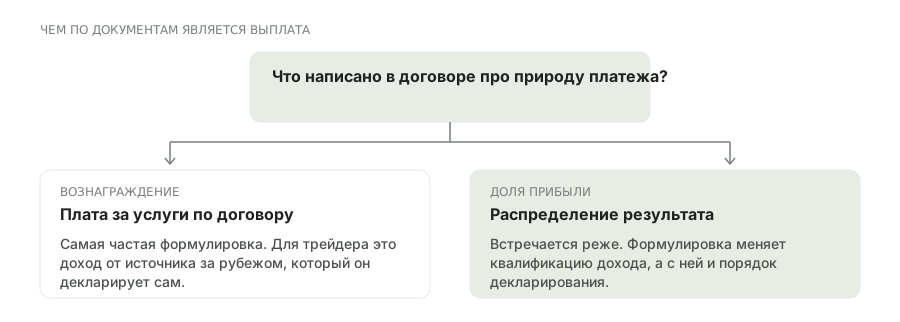
Two wordings occur, and they classify the income differently. Which one your firm uses is visible in the contract, in the section on the nature of the payment.
| Wording | How it looks in the contract | What follows from it |
|---|---|---|
| Remuneration for services | Payment for services, trader fee, reward | Income from a foreign source; the recipient declares it themselves |
| A share of profit | Profit share, distribution of profit | The classification may differ; the procedure depends on the jurisdiction |
In practice the first variant is more common: the firm documents the payout as payment for services under a contract. That is consistent both with its own logic — it sells an evaluation rather than raising capital — and with the fact that the account belongs to it rather than to you.
Income tax on prop trading: six questions before the first payout
They are worth settling in advance, because once the money has arrived nothing can be changed, and the data will be needed when declaring.
The wording from the contract, word for word. It determines the classification of the income and which documents you will need.
from the contractThe payer's country affects whether double taxation treaties apply.
from the payment detailsUsually not, but if it does you need a certificate, otherwise there will be nothing to prove what was paid.
ask in writingAn account statement, confirmation of the transfer, an invoice. Ask for them at the moment of payout: obtaining them after the fact is harder.
collect them at onceBoth the rate and the obligation to declare depend on it. Status can change during the year.
your questionThe payout arrives in dollars or a stablecoin, while declaring is done in local currency. The rate is taken on the date the income is received, so two traders with identical payouts will report different local amounts.
it affects the amountFrequently asked questions
Do I have to pay tax on prop firm payouts?
The obligation to declare income and pay tax is determined by the law of your country of tax residency, not by the firm's rules. We are not tax advisers: check the specific procedure with a professional.
Does a prop firm withhold tax itself?
Usually not: it pays an individual in another jurisdiction and does not act as a withholding agent. If there is a withholding, you need a certificate — without one there will be nothing to confirm what was paid.
How is a payout documented?
Most often as remuneration for services under a contract. A wording about the distribution of profit is less common. The exact wording has to be read in your own contract: the classification of the income depends on it.
What does the rate depend on?
On tax residency, the classification of the income, the payer's jurisdiction and whether a double taxation treaty applies. Any specific figure without that data will be wrong for some cases.
What should I put into the payout calculator?
The rate that applies to your case. The 13% in the examples is an example, not a recommendation: it shows the mechanics of the deduction, not your tax.
Does the challenge fee count as an expense?
That depends on how the income is classified and on what your country's law allows. It is a substantive question and worth putting to a professional before the first payout.
Which documents should I ask the firm for?
An account statement for the period, confirmation of the transfer and, if the firm issues them, an invoice or an act. Ask at the moment of payout: restoring documents after the fact is harder.
Does anything change if the payout is in cryptocurrency?
How such income is treated varies between countries far more than for a bank transfer, and you have to record the rate on the date of receipt yourself. That is a separate question for a professional, not a detail.
Does the status of a payout matter for anything besides tax?
Yes, for provability. The wording “remuneration for services” rests on a contract you paid for, and in a dispute that is a clearer construction than “distribution of profit” with no defined share.
Where can I see how the pre-tax amount is worked out?
In the payout-after-split calculation: it shows that tax is taken from your share rather than from the trading result, and that the order of deduction is fixed.
Read next
