 PPTF
PPTFProp trading risks and the revenue model
Prop trading risks are easier to examine through the question “what does the firm earn on” than as a list. We work out why prop firms earn on fees, in which case those who reach a payout are in their interest, and by which signs the two can be told apart before you pay.
Two models and where the interests diverge
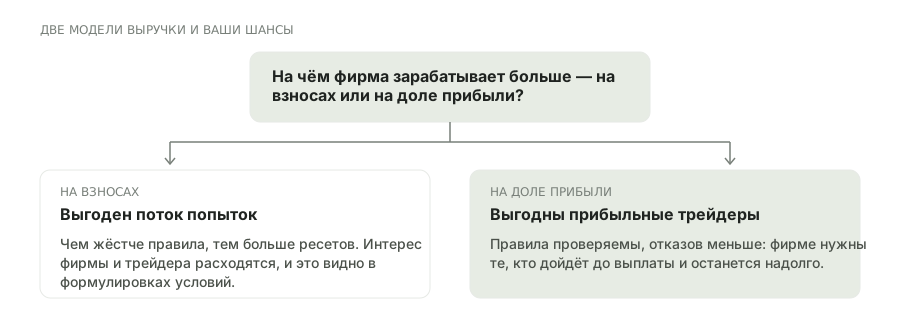
A prop firm takes money from two sources: payments for attempts, and the difference between traders' results and the share paid out to them. Which of the two dominates decides whether its interests coincide with yours.
| Revenue from fees | Revenue from a share of profit | |
|---|---|---|
| What is in the firm's interest | A flow of attempts and resets | Traders who reach a payout |
| How it shows in the rules | Tight limits, broad wordings | Verifiable terms, a list of grounds for refusal |
| What happens to the reset price | Low — so that people come back | High, or there is no reset at all |
| Do the interests coincide | No: your failure is its revenue | Yes: your profit is its profit |
An important caveat. The first model does not mean fraud. Selling attempts with a low probability of success is lawful if the terms are honestly described — as it is lawful to sell lottery tickets. The problem is not the model but the fact that under it the firm has no reason to make the rules unambiguous.
Why prop firms earn on fees
The arithmetic is simple. At a probability of passing of around 10%, out of ten paid attempts roughly one reaches a funded account, and only some of those get a payout. All ten pay the fee.
It follows that the flow of attempts is the most predictable income in this model: it does not depend on the market, on traders' skill or on results. Payouts, by contrast, arrive unevenly and reduce the result. For a business that means it is easier to grow by increasing the number of buyers than the share of successful ones.
How to tell the model before paying
Nobody writes about this outright, but the construction of the terms gives away the firm's bet. Four signs, each checked in minutes.
Signs of a bet on the flow of attempts
- A cheap reset alongside tight limits
- The combination pays only on an expectation of repeat purchases: strict limits produce failures, a cheap reset brings the customer back.
- Broad wordings of the bans
- “Strategies that exploit execution conditions” with no list. It reserves the right to refuse a payout where the rules were formally not broken.
- No list of grounds for refusal
- A model that lives on a share of profit has an interest in predictable payouts: it needs long-term traders. Listing the grounds is in its interest.
- An aggressive affiliate programme
- High payments per referred customer mean the firm is paying for a flow of buyers — that is, it treats them as the revenue.
No single sign is proof. But three or four together mean the terms deserve especially careful reading — and that the cost of passing should be worked out with a pessimistic probability.
Frequently asked questions
What are the main risks of prop trading?
Losing the fee on a breached limit, losing profit earned but not withdrawn, a refused payout under a broad wording, and lost time — weeks per attempt. The first risk is capped and predictable; the other three depend on the particular firm's terms.
Why do prop firms earn on fees?
Because everyone pays the fee and only some receive a payout. At a probability of passing of around 10%, roughly one in ten attempts reaches a funded account. The flow of attempts is the most predictable income in this model.
Does that mean my failure is in the firm's interest?
In a model that lives on fees — yes, statistically. In a model that lives on a share of profit — no: it needs traders who reach a payout and stay. The two can be told apart by the construction of the terms.
Is selling attempts with a low probability even lawful?
In itself yes, if the terms are honestly described. The problem is not the model but unverifiable wordings: they make it possible to avoid an obligation where the rules were formally not broken.
Which signs reveal a firm's source of revenue?
Four of them: the price of a reset relative to the fee, how broad the wordings of the bans are, whether there is a list of grounds for refusal, and how generous the affiliate programme is. Three or four together are a reason to work on the pessimistic scenario.
Does a mark-up on the spread change anything?
Yes, it adds a third source: revenue from turnover. A firm with such a mark-up has an interest in active traders whatever their profitability — an intermediate case between the two models.
Does the model affect the probability of passing?
Not directly: the probability depends on your numbers and the limits. But the model affects the limits and how unambiguously they are described — and through that, the outcome.
Is it worth choosing a firm that lives on a share of profit?
If you can identify one, yes: its interests are closer to yours. But what you check is still the terms rather than the declarations: “we earn together with our traders” is written by everyone.
Is there data on how much a firm earns from fees?
Online programmes publish no accounts. Numbers have surfaced in court papers: the CFTC's suit against My Forex Funds cited over 135,000 clients and no less than $310m in fees. But those are figures from a statement of claim, and the suit was later dismissed in full — they speak to the scale of the business, not to a proven breach. The case in full is in the red flags analysis.
How does a firm's model show up in my own calculations?
Through the probability you should put in. Where there are signs of a bet on the flow of attempts, take the pessimistic estimate and work out the cost of passing with a larger number of resets — that will be the realistic budget.
Read next
