 PPTF
PPTFProp trading in Russia and the CIS
Prop trading in Russia runs into not a ban but four practical obstacles. We work out what happens with the availability of programmes, paying the fee and receiving a payout in Russia, and how prop trading in Kazakhstan, Ukraine and Belarus differs in circumstances.
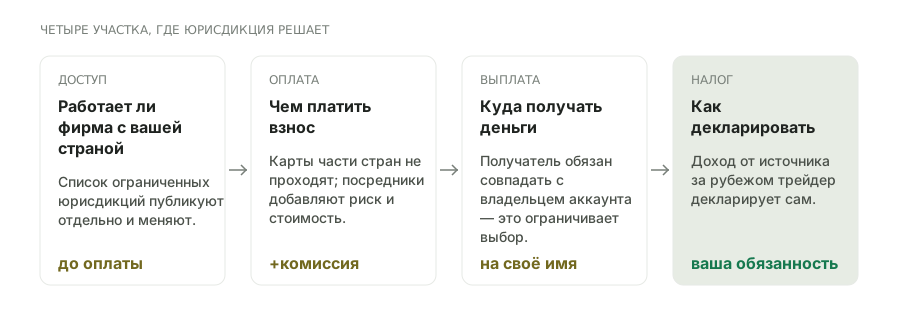
Four places where jurisdiction decides
There is no ban on taking part in a challenge: you are buying a service from a foreign company. The difficulties arise in four specific places, and all four can be checked before paying.
| Segment | What the difficulty is | When to check |
|---|---|---|
| Availability of the programme | The list of restricted jurisdictions is published separately from the rules and changes | On the date of purchase |
| Paying the fee | Cards from some countries are declined; intermediaries add cost and risk | Before buying |
| Receiving a payout | The payee must match the account holder; the choice of methods is narrow | Before buying |
| Declaring the income | Income from a foreign source is declared by the recipient | Before the first payout |
The worst order of events. Buy a challenge, pass both stages, earn a profit — and find out at verification that the country is on the restricted list or that there is no available payout method in your own name. The fee in that case is usually not returned, and the profit stays on an account you no longer have access to.
Prop trading companies in Russia: do they exist
Russian prop firms in the same sense as foreign online programmes barely exist — and the reason is not a ban but the model. It is built on taking payments from dozens of countries and paying out abroad; for a company working inside one jurisdiction that construction does not add up.
What you find instead:
Prop trading in Kazakhstan, Ukraine and Belarus
The circumstances differ not in prop firms' rules but in payment infrastructure and tax regime. A prop firm looks at the country of residence and the available transfer methods — the rest is a matter of local law.
What differs between countries
- Availability of programmes
- Firms' lists of restricted jurisdictions differ and change. One and the same firm may work with Kazakhstan and not with another country in the region — it can only be checked on the date of purchase.
- Methods of payment and payout
- This is where the main difference lies. Where cards and wallets work, the question is simple; where they do not, intermediaries appear, and with them cost and the risk of a payee mismatch.
- The tax regime
- The rate and the procedure for declaring income from abroad are set by local law. We are not tax advisers: the questions are set out on the page about taxes and the status of payouts.
Frequently asked questions
Is prop trading lawful in Russia?
There is no ban on taking part in a challenge: you are buying an evaluation service from a foreign company. The difficulties arise not with the legality of participation but with the availability of programmes, payment, receiving a payout and declaring the income.
Are there prop trading companies in Russia?
Equivalents of the foreign online programmes barely exist, and the reason lies in the model: it is built on taking payments from dozens of countries and paying out abroad. What you do find are office teams at brokers and training programmes with account access.
How do I pay the fee if my card is declined?
There are methods, but each adds cost and risk: intermediaries, cryptocurrency, cards from other jurisdictions. The main restriction comes later — the payee must match the account holder.
How do I receive a payout in Russia?
Only to details in the account holder's own name. The set of available methods is narrow and it changes, so check it before buying a challenge rather than after the first profit.
What happens if my country turns out to be on the restricted list?
Usually a refusal at verification and no way of receiving a payout; the fee is not returned. The list is published separately from the trading rules and it changes, so look at it on the date of purchase.
How is the situation different in Kazakhstan?
The prop firms' rules are the same; what differs is the payment infrastructure and the tax regime. In practice that means a wider choice of working payment and payout methods, but availability at a particular firm still has to be checked.
Prop trading in Ukraine and Belarus: what to bear in mind?
The same in structure: availability of the programme, the payment method, the method of receiving and the local tax procedure. The differences between countries in the region lie in the payment side rather than in the firms' rules.
Can I register under a different country?
Giving false details breaches the contract, and the discrepancy surfaces at verification — together with the profit earned by then. That is not a way round the restriction but a deferred refusal.
Do I need a licence to take part?
No, you act as an individual — a buyer of a service. A licence is discussed in relation to the firm, and its absence is usually normal for the prop model: no third-party funds are raised.
Where do I check whether a firm works with my country?
In the section on restricted jurisdictions — it is published separately from the trading rules, sometimes in the general terms. If there is no list anywhere, that is a reason to ask in writing and keep the answer.
Read next
