 PPTF
PPTFMaximum drawdown: static and trailing
Maximum drawdown is the second limit of a challenge, and it does not reset. Trailing drawdown is a variety of it in which the boundary travels behind the account's peak. We work out what maximum drawdown is in both variants and how a trailing drawdown turns what you earned into a new starting point.
Maximum drawdown is a cap for the whole period, not for a day
Maximum drawdown (maximum loss) is the limit on the loss over the whole life of the account. Unlike the daily one it never resets: cushion spent is not returned. That makes it softer in the moment and harsher over distance — a bad week spends the limit for good.
It is usually written with the same number as the daily one — “10%” — and that is exactly why they are confused. The difference is not in the size but in the base and in how the boundary behaves. There are two bases, and the choice decides whether profit builds a cushion.
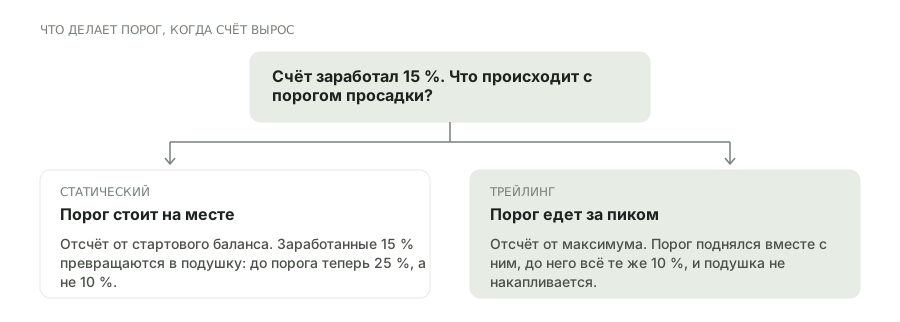
Measured from the account's starting balance. The boundary stays put, so every per cent earned increases the distance to it.
profit = cushionMeasured from the highest value reached. The boundary rises with the peak and never comes back, so the cushion is always the same.
profit = a new starting pointAn intermediate variant: the threshold travels behind the peak until it catches up with the starting balance, and then freezes. After that point a cushion does begin to build.
mixedA separate question on top of both variants. If the peak is recorded on equity, the threshold is lifted even by an open position that has merely been in profit.
always checkTrailing drawdown: why accounts are closed while in profit
This is the consequence that makes trailing drawdown worth a section of its own. If the threshold is measured from the peak, then after the account grows it ends up above the starting balance — and a pullback from the peak closes an account that is still in profit against the start.
The situation does not always arise, only when the profit at the peak exceeded the size of the limit. With a 10% limit and a 15% peak it takes a pullback from the peak of between 8.7% and 13%: the first is the moment equity falls below the trailing threshold, the second the moment it reaches the starting balance. In that interval the account is formally closed and formally in profit.
Which strategies trailing breaks
Trailing punishes unevenness, not losses. The larger a single winning trade, the higher the threshold is lifted — and the less room is left for the next run of stops.
Hence the practical conclusion: comparing programmes by the number “10%” is pointless. A static 8% can turn out softer than a trailing 12% if your curve is uneven.
Frequently asked questions
What is trailing drawdown?
It is maximum drawdown measured from the highest value the account has reached. Earn, and the threshold rises by the same amount. The distance from current equity to the threshold does not grow with profit.
Is maximum drawdown the same as the daily one?
No. The daily one resets every day, the maximum never resets. The numbers in the rules often coincide, which is why they are confused, but they work differently.
Is a trailing threshold the same as trailing drawdown?
Yes, the terms are interchangeable. Alongside them you will meet “creeping floor” and “floating drawdown”. In the rules, look for the English term: it is unambiguous.
How do I find out whether a firm's threshold is static or trailing?
By the words static and trailing next to maximum loss. If it says only “max loss 10%”, the base is undefined — that is a reason to ask support in writing and keep the answer.
How high does a trailing threshold rise?
Either without limit behind the peak, or up to the starting balance and then it freezes. The second variant is softer: after it, profit starts working as a cushion. The wording looks like “trails up to your initial balance”.
What happens to the threshold after a payout?
Usually the balance is reset to its original size and the threshold is recomputed with it. For trailing programmes that means the accumulated cushion disappears and the room is minimal again.
Is the peak recorded on balance or on equity?
It depends on the programme, and it is a separate question on top of the threshold type. On an equity base the threshold is lifted by an open position that was in profit and then came back to zero: nothing was earned, and the cushion shrank.
Which variant should I choose at the same challenge price?
The static one, if your curve is uneven or your trades are long. The difference between static and trailing at one and the same number is bigger than the price difference between most programmes.
Can maximum drawdown be worked out if the limit is set in money?
Yes, convert it into a percentage of the account size: $10,000 on a $100,000 account is 10%. The logic of the thresholds does not depend on how it is written.
Does maximum drawdown apply on a funded account?
Yes, exactly as on the stages. Only the profit target disappears; both limits remain, and the account is lost by them.
Read next
