 PPTF
PPTFHow a prop firm works
How a prop firm works is easiest to see from its revenue: it takes money up front for attempts, while payouts to successful traders sit on the cost side. We work out how a prop firm makes money and why prop trading differs from a fund more than it seems.
How a prop firm makes money
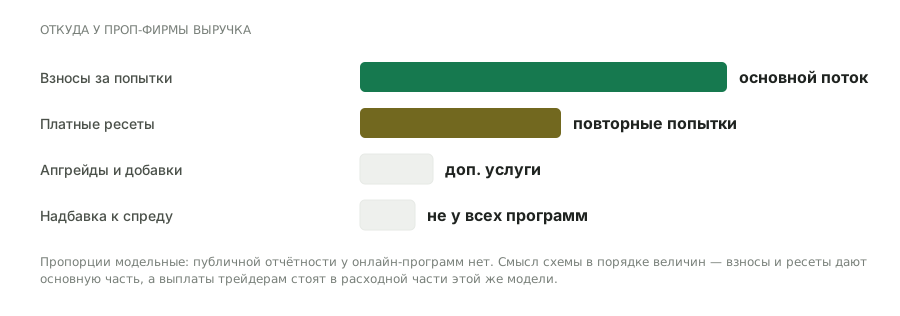
Revenue comes from four sources, and the first two provide the bulk of it. Online programmes publish no accounts, so the proportions here are model ones — but the order of magnitude follows from the construction itself: payments come up front and do not depend on the result, while a payout arises only for those who reach one.
The main flow. Every attempt is paid for whatever the outcome, which is exactly why the number of attempts matters to the firm more than their success.
arrives immediatelyThe second largest. A reset is cheaper than a new challenge, so the trader chooses it — and pays a second, third, fifth time.
repeatableA larger account size, removing the stage deadline, a higher split for an extra payment. A small share, but pure margin.
optionalNot at every programme. Where execution is internal, part of the spread stays with the firm — and grows with your turnover.
depends on the modelWhat follows from this in practice. Read the wording of the terms with the question “who benefits from this ambiguity”. A rule with no base stated, a news window with no published calendar, a payout “at the company's discretion” — each of them increases the share of attempts that never reach a payout. It is not necessarily bad faith, but these are exactly the places to check.
Prop trading against a fund: who risks what
A fund and a prop firm look similar — both let you trade money that is not yours. The difference is where that money comes from and to whom obligations are owed.
| Prop firm | Investment fund | |
|---|---|---|
| Whose money is at risk | The firm's own funds | Investors' funds |
| Who pays up front | The trader — a fee for an attempt | The investor — puts up the capital |
| To whom obligations are owed | To the trader under a contract | To investors and the regulator |
| Is a licence needed | Usually not: no funds are raised | As a rule yes |
| What the trader loses on failure | Fee | The job or the mandate |
Hence a practical conclusion that is often stated wrongly. There is no point in making of a prop firm the demands you would make of a fund — it does not manage your money, because none of your money is on the account. But a line such as “we are not a financial institution” does not release it from the obligations of the service contract you paid for.
Prop trading companies: three types under one word
The phrase “prop trading companies” covers three different constructions, and confusing them is the source of most arguments about whether it is “real” prop.
The “bad” class here does not mean “bad”: it means “needs the most careful reading of the terms”. The model works in this form too — but it has the most places where interpreting a rule falls to the firm.
What that changes in your own arithmetic
If a payout is the firm's expense and the fee is its revenue, then the price of access for you is not the price of the challenge but the cost of passing: there is usually more than one attempt.
Frequently asked questions
Do prop firms hire traders as employees?
Online programmes almost never do: the relationship with the trader ends with a contract for the evaluation and the payment of a share. Hiring, internships and training at the firm's expense belong to office desk companies, and the difference between the two models is covered in the piece on learning and working in prop trading.
How does a prop firm work in plain words?
It sells a paid evaluation. You buy an attempt to pass its test; if you pass, you get the firm's account and a share of the profit. Fees reach the firm immediately and do not depend on the outcome, while payouts come from its own funds and only to those who get that far.
What does a prop firm make most of its money on?
On fees for attempts and on paid resets. Upgrades and the spread mark-up give a smaller share. There are no public accounts, but the construction is obvious: payments come up front, while a payout arises only for some of the clients.
How does prop trading differ from a fund?
In the source of the money and in the obligations. A fund risks investors' money and reports to them and to a regulator. A prop firm risks its own funds at payout, raises no investor money and usually holds no licence.
Does that mean a prop firm owes nothing?
No. The absence of a financial licence does not cancel the service contract you paid for. Obligations exist, but their scope is set by the rules — which is why you should read the rules rather than reviews.
What kinds of prop trading companies are there?
Three types: office desk teams with hiring and salaries, online programmes with simulated accounts, and a rare hybrid where after several cycles the account is moved to real execution. The second type makes up most of the market.
Why would it suit a firm for traders to fail?
That is true only of the model that lives on fees: there the flow of failed attempts is the revenue. A model that lives on a share of profit earns from the opposite — from traders who reached a payout and stayed. You can tell them apart by how verifiable the rules are.
How can you tell what a particular firm earns on?
By indirect signs: how unambiguous the wording is, whether a news calendar is published, the list of grounds for refusal, the price of a reset relative to the fee. A cheap reset alongside tight limits is a sign of a bet on the flow of attempts.
Do prop firms have a regulator?
As a rule no, and that follows from the model: no third-party funds are raised, so the firm does not fall under the licensing of financial institutions. Jurisdiction matters for something else — where to bring a claim if a payout is not made.
Can a prop firm close down with traders' money?
Unrequested profit on the account is an obligation of the firm, not an asset of yours held in custody. That is exactly why it should not be allowed to pile up: payout frequency is not a formality but a way of shrinking that sum.
Read next
