 PPTF
PPTFEditorial policy
An editorial policy is not a declaration of good faith but a list of rules, every one of which can be checked against the site itself. Here is how we handle numbers and disputed claims, what we do not write as a matter of principle and what we do with an error once found.
Six rules for handling numbers
A firm's rule comes with a reference and a date. A market estimate comes with its author named. A calculation comes with the formula in the text alongside. A number lacking one of the three does not get published.
verifiableIf the numbers were chosen for illustration, that is said outright. The reader must be able to tell “this is how it is at FTMO” from “this is how it is in our example”.
distinguishableEvery calculation has a section on what it does not account for, and which way that shifts the result.
in the openA challenge pass rate of 5–10% is an aggregators' estimate, not firms' data. The words “by estimates” stand next to the number rather than in a footnote.
with attributionThe My Forex Funds case — the CFTC suit and its dismissal with costs awarded against the CFTC itself. The claim that “forex props do not exist” — with its author named and checked against the facts.
in fullA page starts from a search query, but the answer to it is not bent to what the person wants to hear. If the right answer is “this is not worth doing”, that is what is written, even when the query is phrased as “how to do it”.
checkable in the textWhat we do not write as a matter of principle
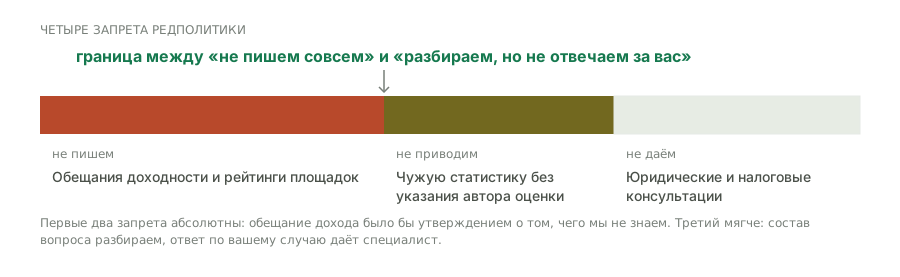
Four prohibitions, and they outrank convenience. Each can be checked by searching the site.
What we do with an error
Errors in calculations happen, and the rule here is simple: the cause is corrected, not the symptom. If a number on a page has diverged from the calculator, what gets corrected is not the number but what produced it — otherwise the divergence comes back.
The order is this. The error is reproduced: we have to see it ourselves rather than take it on trust. Then the cause is found — in the formula, in an assumption or in the source. Then the correction is made everywhere the same number appears: the check for contradictions between pages is part of the process rather than something done occasionally.
What counts as an error
- A number that cannot be repeated
- If the formula in the text gives a different result from the widget, that is an error, even if both look plausible.
- A claim with no source
- A firm's rule with no reference and no date, an estimate with no author. Even if correct in substance, it breaks the rule of verifiability.
- A divergence between pages
- One and the same value on two pages has to match. A divergence means one of them is out of date.
Frequently asked questions
Why are there no promises of returns on the site?
Because income depends on your statistics and your size, not on prop trading as a model. Any promise would be a claim about something we do not know.
Why do you not write rankings?
The order in public prop firm rankings usually reflects affiliate arrangements rather than quality. And compatibility of the limits with a strategy is personal: there is no single “best” here.
How do you handle disputed claims?
We give both sides with their authors named. The My Forex Funds case — the CFTC suit and its dismissal with costs awarded against the CFTC itself. The claim that “forex props do not exist” — with attribution and a check against the facts.
Do you give legal advice?
No, nor tax advice. On the relevant pages we lay out what the question consists of and what to clarify with a professional, but responsibility for the decision stays with the reader.
What should I do if I find an error in a calculation?
Write to us naming the page, the disputed number and the result you got yourself. We reproduce the error, find the cause and correct it everywhere the same number appears.
Do you correct old pages?
Yes, when firms' rules change or a divergence comes to light. The date checked is in the editorial signature — that is what to look at when judging how current something is.
Why are model examples marked separately?
So that the reader can tell “this is how it is at a particular firm” from “this is how it is in our illustration”. Confusing those two is the most common error in texts about prop trading.
Do you publish material from firms?
No. Press releases, guest articles and reviews commissioned by firms are not placed on the site. If that ever changes, a mark will appear both in the policy and in the material itself.
How do you decide that a number is out of date?
By the date checked and by the source itself: firms' rules change without notice, which is why the date stands next to the number. We always advise the reader to verify the terms in the rules on the date they apply.
May I suggest a topic?
Yes, through contacts. We choose topics by the questions people actually ask, so a suggestion phrased as a real question is more useful than the name of a topic.
Read next
