 PPTF
PPTFDaily drawdown
Daily drawdown is the cap on the loss over a single day, and it is the most common reason accounts are closed. We work out what daily drawdown is by the documents: what it is measured from, when it resets and what goes into the calculation besides closed trades.
What daily drawdown and the daily loss limit are
Daily drawdown is the maximum loss an account may take over a single trading day. The wording daily loss limit (in the rules, daily loss limit) carries the same meaning: it is one and the same condition written in different words. Breaching it closes the account immediately, whether or not there is accumulated profit on it.
Unlike maximum drawdown, the daily one resets: every day the account gets the full limit again. Both its main property and its main trap follow from that. The property: a run of bad days does not add up into one cushion. The trap: within a single day the cushion is finite and is spent faster than it seems, because it is not only closed losses that count.
Three values to write out of the rules
- The reference base
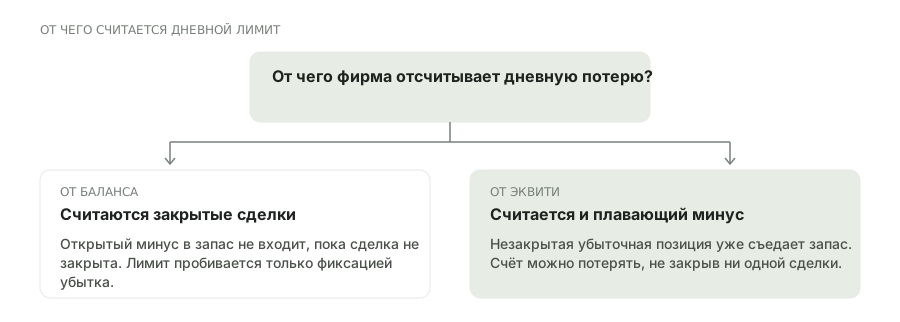
- From the balance at the start of the day or from equity. The difference is decisive: in the second case an open losing position already reduces the cushion.
- The reset moment
- The hour and time zone at which the firm's new trading day begins. It almost never coincides with your local midnight.
- What goes into the calculation
- At some firms commission and swap also reduce the cushion. For a high-turnover strategy that is a noticeable amount, not a rounding error.
From balance or from equity: two different rules
The wording “daily limit 5%” without naming the base is not a rule but half a rule. Counting from closed trades and counting from equity are two different trading regimes, and the second is stricter.
| Base — balance at the start of the day | Base — equity | |
|---|---|---|
| What counts as a loss | Only realised losses | Realised plus floating |
| An open loss | Does not count until it is closed | Eats into the cushion immediately, in real time |
| Can you sit out a drawdown | Yes, if the position comes back | No: the limit triggers before it comes back |
| What to do about lot sizing | Size from the stop distance | Size from the stop plus room for a move against you |
Practical consequence. With an equity base you can lose the account without closing a single trade: it is enough for an open position to run against you by the size of the limit. Strategies that “let the price breathe” and hold a wide adverse move are impassable on such a base at any size but the minimum.
The reset moment: why the firm's day is not yours
The new trading day begins at the moment the firm sets, not at your midnight. Most often it is tied to the platform's server time or to the close of the US session. Two effects follow, and both break a day plan.
The first: trades opened in the evening and closed at night can land in different trading days of the firm — and the loss is split between two cushions. The second, the reverse and the dangerous one: two trades you think of as “today's” can land in the same firm day and add up into one limit. This is checked once, in the description of trading hours, and after that simply taken into account.
How the daily limit sets position size
Daily drawdown is not an upper bound you remember after a bad day. It is the starting value for position sizing: risk per trade follows from the limit divided by the run of stops the account has to survive.
The reverse calculation — how many stops in a row an account survives at a chosen risk — is in the losing-streak simulator. Both calculations are about the same restriction, just approached from different sides.
Frequently asked questions
What is daily drawdown in plain words?
It is how much money the account may lose in a single day before it is closed. Every new trading day the limit is issued again, so it cannot be saved up for several days ahead.
Are daily drawdown and the daily loss limit different things?
No, the same condition. “Drawdown” describes the size of the loss, “loss limit” the boundary beyond which the account is closed. Both words appear in the rules, along with the English daily loss limit.
Does an open loss count?
It depends on the base. If the limit is measured from equity — yes, a floating loss reduces the cushion at once. If from the balance at the start of the day — no, it does not count until the trade is closed. That is the first thing to establish in the rules.
When does the daily limit reset?
At the moment set by the firm — usually by the platform's server time. It rarely coincides with your local midnight, so check the clock once, before you start trading.
Do commission and swap count towards daily drawdown?
At some firms they do, and then the cushion is smaller than the trades suggest: the day's turnover commission and the swap for holding overnight reduce it just as losses do. Look for this in the description of how the limit is calculated, not in the section on fees.
What happens if you breach the daily limit on a funded account?
The same as on a stage: the account is closed. Limits are not softened after the evaluation, and there is more to lose — the unrequested profit goes with the account.
Can an account be restored after a breached daily limit?
Only with a paid reset, if the programme offers one, and not always: some firms allow a reset after a failure but not after a breach. That condition sits next to the description of the reset.
How do I tell that the daily limit is too tight for my strategy?
Work out the size allowed by your worst losing streak. If it comes out below the firm's minimum lot or is incompatible with your stop, the limit is tight for you specifically — and that is an answer about choosing a firm, not about discipline.
Is daily drawdown measured from the current account size or the starting one?
Usually from the account size at the start of the day, not from the original size at purchase. On an account that has grown the limit in money terms is therefore larger — but in trailing programmes the maximum threshold rises with it.
Is there a daily limit in instant funding?
As a rule yes, and often tighter than in two-step programmes: there is no profit target, so the limits are the only filter left. Put them into the sizing calculation exactly as you would for a challenge.
Read next
