 PPTF
PPTFWhat prop trading is
In short, what prop trading is: trading on an account that does not belong to you. Below: what the word covers today, how online programmes differ from classic prop and what the fee actually buys.
The definition everything else follows from
Prop trading (from proprietary trading — trading for the company's own account) is a trader working on the firm's capital with the result split between them. The trader pays in no deposit and cannot dispose of one; they get access to an account with rules and a share of the profit.
The word covers two different things, and confusing them is the source of most arguments. Classic prop took shape in the 1980s: banks and brokerage houses assembled in-house desk teams that traded the employer's money for a salary and a bonus. The modern online model sells something else — a paid evaluation: you buy an attempt to prove that you trade within the rules, and only then do you get an account with a share of the profit.
| Classic prop | Online programme | |
|---|---|---|
| How you get in | Hiring, an interview, an internship | Payment for the challenge, with no CV screening |
| Who pays up front | The firm — a salary to the trader | The trader — a fee for an attempt |
| The money on the account | The firm's real capital | Notional in most programmes |
| What you lose if you fail | Your job | Fee |
| Income | Salary plus bonus | Only a share of the profit, no salary |
The historical division and the typology of firms (office, online, hybrid) follow a review by Gerchik & Co; the source is linked in the methodology.
A prop firm is neither a fund nor a broker
Three models are constantly mixed up, though they answer the main question differently: whose money is at risk and who owes what to whom.
Hence the practical conclusion: you cannot make of a prop firm the demands you would make of a fund — it does not manage your money, because none of your money is on the account. And you cannot expect broker-like neutrality from it: the firm both sets the rules and judges compliance with them.
What the fee buys
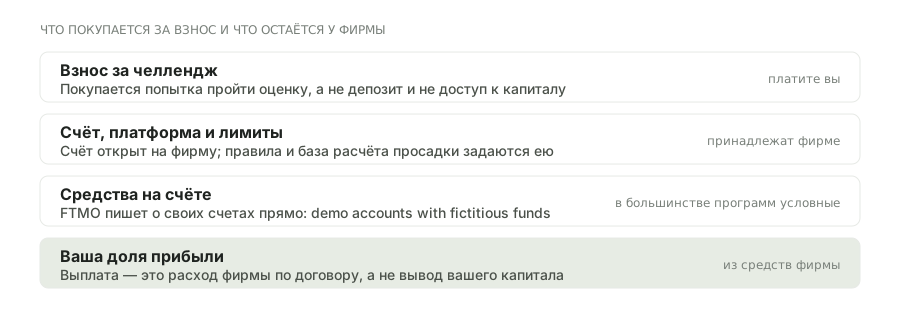
Shop-window wording (“get capital of up to $200,000”) describes the size of the account, not a sum handed to you. FTMO says so plainly: all accounts we provide to our clients are demo accounts with fictitious funds — the accounts are demo, the funds on them notional, and “up to $200,000 simulated capital” is about simulated capital.
That is not a sign of deception: the mechanics work this way by design. The firm gets a flow of applications and statistics on decisions, and makes payouts from its own money under a contract. But two practical conclusions follow, and they change the arithmetic.
Two consequences for the trader
- You cannot “withdraw the deposit”
- There is nothing to withdraw: the fee pays for a service, it does not top up an account. So a challenge should be compared not with a deposit at a broker but with buying an attempt that has a price and a probability.
- Your share is the firm's expense
- A payout reduces its result, while fees and resets increase it. What to check is not the promises but how unambiguous the rules are: an ambiguous rule works in favour of whoever interprets it.
When a challenge is not needed
A challenge solves one problem: it gives size when your own capital is small and caps the loss at the price of the fee. If your problem is a different one, the tool is redundant.
Frequently asked questions
What is prop trading in plain words?
You trade on the firm's account under its rules and split the profit with it. You pay no money onto the account; you pay for an attempt at the evaluation. Breach the drawdown limit and the account is closed, with the fee staying with the firm.
Are a prop trading company and a prop firm the same thing?
Yes, they are the same thing, only the wording differs: “company” is the more formal word, “firm” follows the English prop firm. The distinction that matters is a different one: an office team with hiring, or an online programme with a paid challenge.
Is it true that there are almost no legitimate prop companies?
The estimate that “about 10% of companies in the post-Soviet space are legitimate” belongs to the author of a Gerchik & Co review and is not backed by verifiable statistics. We quote it as an opinion, not as a fact. The practical conclusion is more useful than the figure: check not a reputation by hearsay but whether the rules are published in writing and whether the drawdown base in them is unambiguous.
Do you need experience to buy a challenge?
Formally no: the online model has no CV screening. In practice the evaluation is built so that without statistics of your own you pass it by chance, and a chance pass does not repeat on a funded account.
Who owns the account I trade on?
The firm. The account is opened in its name with its broker or on its platform, and you get access to it under a contract. Everything else follows from that: you cannot withdraw “your” funds, change broker or move the trade history to another account.
Is the money on a prop account real?
In most online programmes, no. FTMO says so plainly: “all accounts we provide to our clients are demo accounts with fictitious funds”. That does not make the model a fraud: the payout comes from the firm's real funds under a contract. But a challenge cannot be compared with a deposit at a broker.
Where does a prop firm get the money for payouts?
From fees for attempts, paid resets, upgrades and, at some firms, a mark-up on the spread. Payouts to successful traders are the cost side of that model. Hence the built-in tension: the more unambiguous the rules, the less room there is for a dispute at payout.
Is prop trading a job or a service?
In classic prop it is a job: hiring, salary, bonus, a desk team. In the modern online model it is a service you buy. Mixing the two senses is exactly what produces the argument about whether “it is real prop”: the phenomena differ, the word is the same.
Can you move from an online programme into an office team?
There is no direct route: these are different markets. Statistics from a funded account sometimes help at hiring, but office teams look at their own sample and run their own selection. A challenge is not a CV.
What is instant funding and how does it differ from a challenge?
It is access to an account with no evaluation stage: pay the fee and get the account straight away. There is no profit target, the drawdown limits remain, and the fee is usually noticeably higher. The model is not softer, just differently distributed in risk: the firm takes more up front but does not spend your time on stages.
Read next
