 PPTF
PPTFProp challenge: stages and targets
A prop challenge is an evaluation against formal rules. Below: what it consists of, which conditions are checked automatically and why the profit target turns out not to be the hardest of them.
The profit target of a challenge is not the hardest condition
Formally there is one condition to meet — reach the profit target. In practice the target is the easy part and it is the restrictions that filter people out: two drawdown limits, a minimum number of trading days and rules on how profit is spread across days. Breaching a limit ends the evaluation on the spot, at that very moment, with no review and no second attempt.
So a challenge at a prop company should be read as a list of grounds for failure, not as a return target. Reaching 10% is possible with one good trade; staying inside a 5% daily limit while doing it is a separate task, and it is solved by position size, not by entry precision.
| Condition | What it checks | What happens if you breach it |
|---|---|---|
| Profit target | Whether the stage result is reached | The stage simply is not closed, the account lives on |
| Daily limit | The loss over a single day | The account is closed immediately |
| Maximum limit | The loss over the whole period | The account is closed immediately |
| Minimum days | That the result was not made in a single run | The stage does not close until it is met |
| Consistency rule | That the profit was not made on one day | The payout is trimmed or refused |
How many stages there are
The two-step scheme is the most widespread: the first stage tests the ability to make money, the second that it repeats. One-step programmes are shorter but make up for it with strictness: FTMO's 1-Step has a 3% daily limit instead of 5%, a trailing maximum instead of a static one, and adds a Best Day Rule: the best day must not exceed 50% of the profit of all winning days.
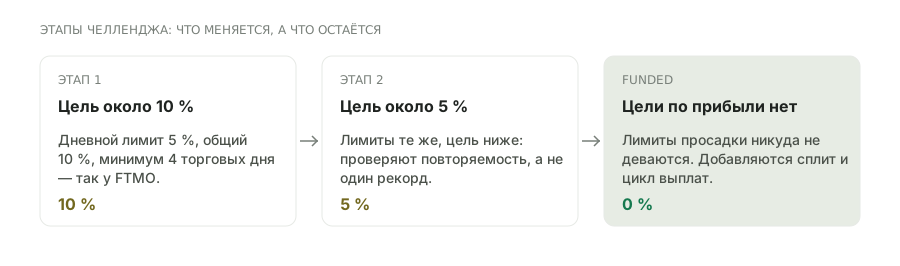
What changes from stage to stage
- Stage 1
- A higher target (10% at FTMO), the same limits. The task is to show a result.
- Stage 2
- A lower target (around 5%), the limits unchanged. The task is to show that the first result was not luck.
- Funded account
- There is no profit target at all. The drawdown limits remain, and the split, the payout cycle and the payout rules are added.
The numbers come from FTMO's Trading Objectives on the date checked. Other firms differ in both targets and limits; one-step and futures programmes are built differently.
The arithmetic belongs before the purchase, not after
Both limits and the stage target set the position size you can afford. If the size is chosen so that a run of several stops in a row breaches the daily limit, the outcome of the challenge is settled before the first trade — and no amount of entry precision changes that.
Deadlines, resets and a second attempt
There was a time when the stage deadline was a hard restriction: miss 30 calendar days and the attempt was gone. Some programmes have dropped it, some have kept a time limit, and some have replaced it with a minimum-activity requirement. This condition needs checking separately: it decides whether you can sit out an unsuitable market or have to trade into it.
A reset is a paid return of the account to its initial state after a breach or a failure. It is cheaper than a new challenge, and that is exactly why it should be counted in advance: if a strategy passes the evaluation in one case out of five, the price of an attempt is the price of the challenge plus four resets, not the price of the challenge.
| What to check in the rules | Why it changes the arithmetic |
|---|---|
| Whether the stage has a time limit | Decides whether you are obliged to trade in unsuitable conditions |
| Whether calendar or trading days are counted | Thirty calendar days is about twenty trading ones |
| The price of a reset and what it resets | Sometimes the progress is reset, sometimes only the breach |
| Whether minimum days reset too | If they do, the attempt takes that many days longer |
| Whether the fee is returned after the first payout | Changes the final price of an attempt, but not everyone promises it |
What begins once you pass
The evaluation is over — the rules are not. On a funded account only the profit target disappears; both drawdown limits stay exactly as they were, and the account is still closed if they are breached. Three conditions are added that the stages did not have.
Frequently asked questions
What is a prop challenge?
A paid test before you get access to the firm's account. You pay for an attempt, trade under set rules and have to reach the profit target without breaching either the daily or the maximum drawdown limit.
How do you pass a prop challenge?
Technically: size the position against the limits rather than against the target, and do not try to close the stage in a single day — minimum trading days and the consistency rule will not let you. There is no guarantee: passing is a probability, not a skill you switch on by deciding to.
What is the usual profit target in a challenge?
For two-step programmes the order of magnitude is about 10% on the first stage and about 5% on the second; at FTMO that is exactly it. But comparing programmes by target is meaningless without the limits: a 10% target with a 3% daily limit is stricter than a 10% target with a 5% one.
Which is tougher, a one-step challenge or a two-step one?
The one-step is shorter in time but tighter in restrictions. FTMO's 1-Step has a lower daily limit (3% against 5%), a trailing maximum and a Best Day Rule. What you should compare is the whole set of conditions, not the number of stages.
How much time is given for a stage?
Some programmes cap it, some do not, others have replaced it with a minimum-activity requirement. This condition changes strategy: with a hard deadline you cannot sit out an unsuitable market. Check it separately and before paying, because the number of attempts depends on it too.
What is a reset and when is it cheaper than a new challenge?
A reset is a paid return of the account to its initial state after a breach or a failure. It is almost always cheaper than a new attempt, which is why its price decides the cost of passing: at a probability of 10% the average bill is one challenge and eight resets.
Do minimum trading days reset with it?
It varies by firm, and it matters: if they do, the attempt takes that many days longer. Look for the wording next to the description of the reset, not in the section on trading objectives.
Are calendar days counted, or trading days?
Usually trading days, but calendar counting occurs too. The difference is substantial: thirty calendar days is about twenty trading ones, and the day plan works out differently.
Can a position be held over the weekend?
Some programmes ban it outright, some cap the size, some do not restrict it at all. A ban on holding over the weekend and on trading in the windows around news is one of the conditions most often broken out of ignorance rather than calculation.
What counts as a breach besides a blown limit?
Trading in a prohibited window, hedging between linked accounts, prohibited classes of strategy, using someone else's access, a mismatch of data at verification. The consequences differ: some breaches close the account, others void a particular payout. The list sits in the section on prohibited practices, and it should be read in full.
Read next
