PPTF
PPTFForex prop trading without promises: rules, drawdown and payouts
Forex prop trading sells not capital but the right to be evaluated. We work out what counts as drawdown, at what moment the account is closed and how much a trader keeps after the split, costs and tax. Rules come from firms' own documents, market estimates carry attribution, and every calculation is laid out so you can repeat it with your own numbers.
Prop trading is an evaluation, not capital
The challenge fee buys an attempt at the evaluation. It does not become a deposit: you cannot trade that money, and if you break a rule it is not returned. The account belongs to the firm, the firm chooses the platform and sets the limits, and in most online programmes the funds on the account are notional — FTMO says so about its own accounts in plain words: demo accounts with fictitious funds.
What changes when the account is not yours
Four differences from which the whole arithmetic follows: from position size to why the payout does not arrive straight away.
What to buy, when to enter and where to put the stop is yours alone. The firm gives no signals and does not manage the position.
stays with youPosition size is derived from the daily drawdown limit, not from the amount on the account. That changes the whole arithmetic of risk.
the main leverIt sets the base the drawdown is measured from and it also checks compliance. An ambiguous rule works in favour of the side that interprets it.
read before payingYour share is paid out of its own funds under a contract, not withdrawn from your account. Hence the threshold, the cycle and the grounds for refusal.
not a deposit withdrawalFrom fee to payout: what happens at each step
Five states the money and the account pass through. Switch between the steps: each one shows what has already been spent, what can still be lost and which rule is at work right there.
The challenge fee
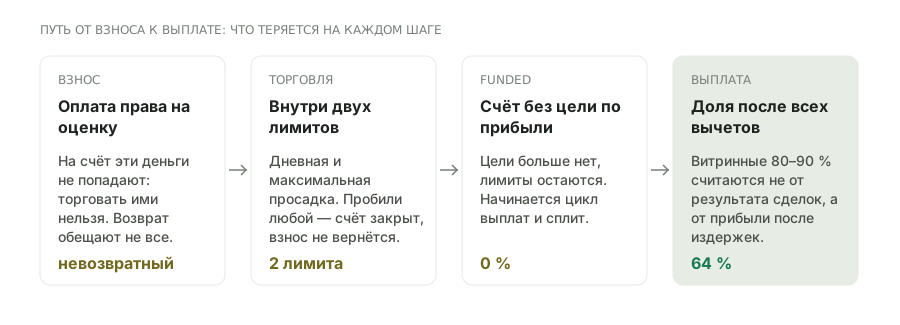
Payment for the right to be evaluated. The money never reaches the account, you cannot trade it, and if a limit is breached it is not returned.
Not every firm promises the fee back after the first payout, and none promise it unconditionally: the condition belongs in the rules, not in the marketing.
The first evaluation stage
You have to reach the profit target without breaching either the daily or the maximum limit. The target is the easy part; it is the limits that do the filtering.
At FTMO the 2-Step target is 10% with a 5% daily limit and a 10% overall one, and a minimum of four trading days. Other firms differ in both the numbers and the base.
The second evaluation stage
A lower target, the same limits. What is tested is not the result but whether it repeats: one lucky run does not close the second stage.
One-step programmes skip this step and make up for it with strictness: a lower daily limit, trailing instead of static, a Best Day Rule.
The account after the evaluation
The profit target disappears, the drawdown limits stay exactly as they were. The split, the payout threshold and the cycle are added.
Limits on a funded account are no softer than on the stages. The account is lost by the same rules — only now there is something to lose.
The payout request
Trading costs, the firm's share under the split and tax on your part are subtracted from the trading result. The order of subtraction is fixed.
In the model example 64% of the trading result reaches the card on a shop-window 80/20 split. For your own numbers, use the payout calculator.
Five steps from buying a challenge to the first payout
The durations on the labels are not a promise but an order of magnitude: they come from minimum trading days, the length of a stage and the payout cycle, not from how fast you trade.
Six filters, all from documents: rules in writing, an unambiguous drawdown base, payout terms without “at our discretion”, jurisdiction and dispute procedure, confirmed payouts and refusals, compatibility with your style.
1–2 eveningsThe allowed lot under the limits, the probability of passing on your own statistics, the cost of passing including resets. If the position size does not fit the strategy, the firm is not for you.
1 hourTrading inside two limits up to the profit target. Minimum trading days set the floor on the duration whatever the result.
2–4 weeksA lower target, the same limits. One-step programmes have no such step, but their first stage is stricter.
2–4 weeksA request once the threshold is met, a consistency check, then the transfer time. This is also where you find out whether the refund of the fee was an obligation or a promise.
weeksThe shop-window split against the money on the card
Two sliders instead of five: all we look at is how the split percentage and turnover together decide what share of the trading result reaches you. The full chain of deductions with amounts is in the payout calculator.
A trading result of $10,000, costs of $4 per lot, a tax rate of 13%. Turnover and rate differ for everyone — what matters here is not the total but the fact that the shop-window percentage and the share of the result are two different things.
Accounts are lost to a breached limit, not to a loss
In a challenge two restrictions are in force at once, and breaching either one closes the account immediately — whether or not it is in profit. The difference between them is the base they are measured from, and the base is where most people get it wrong.
| Limit | What it is measured from | When it resets | FTMO example |
|---|---|---|---|
| Daily | From the day's starting balance or the equity at the start of the day — depends on the firm | Every day at the moment the firm sets | 5% in 2-Step, 3% in 1-Step |
| Maximum | From the account's starting balance (static) or from the peak reached (trailing) | Never: the static one stays put, the trailing one only moves up | 10% static in 2-Step, 10% trailing in 1-Step |
FTMO's rules are given as a documented example, not as an industry standard: other firms differ in both the numbers and the base. Check them in the firm's own rules on the date you apply.
Where the arithmetic costs money. If the daily limit is measured from equity, an open loss already eats into the cushion even though the trade is not closed. And after a new peak the trailing limit moves the threshold up and never comes back: what you earned becomes the new starting point for drawdown.
Are you ready to buy a challenge
Eight questions about you rather than about the firm: without them there is nothing to base the arithmetic on. Whatever you tick is still here next time.
A quick check of a firm against its documents
Six points from the firm's rules. Untick whatever it does not have and the verdict recalculates. The first three points work as vetoes.
The first three points are gates with a veto: without any one of them the verdict is red no matter what the rest say. A points total does not work here — it hands a green light to a firm with an undefined drawdown base and a pretty website. The full checking order is in how to choose a prop firm.
Four mistakes visible before the first trade
Every one of them shows up in the arithmetic in advance, before the fee is spent. Below: briefly what each consists of, and a link to the full analysis.
Position size chosen to fit the target
The lot is calculated from the profit you want rather than from the limit. The daily limit is then breached by an ordinary run of stops — and that is the main reason people fail on the model.
The drawdown base was never read
“Maximum loss 10%” without saying what it is measured from is not a rule. Static and trailing give different cushions at the same number, and equity and balance trigger at different moments.
The cost was counted for a single attempt
The shop window shows the price of a challenge; the calculation needs the cost of passing. At a probability of 10% the expected outlay comes out five and a half times higher than the advertised figure.
The split was taken for the share of the result
The advertised 80–90% is counted from profit after trading costs, and tax is then taken from your part. Noticeably less reaches the card.
Where to start
What a prop firm is, how a prop account differs from your own and when a challenge is not needed at all.
02Challenge rulesStages and targets, both drawdowns, minimum days, the consistency rule, bans and losing the account.
03MoneyThe split, the payout cycle, the price of an attempt, costs, the scaling plan and taxes.
04Choice and risksWhat to look for in the rules, which wordings are red flags and how the model makes its money.
05CalculatorsNine calculations: the allowed lot, trailing, the probability of passing, the payback of the fee.
06ReferenceDrawdown, target, split, reset, consistency rule, KYC — prop trading terms in one list with definitions.
What you will not find here
- Promises of returns
- Not a single page forecasts earnings. Every number is a model example with its assumptions named, and you can recompute all of them for yourself.
- Third-party statistics without a source
- Challenge pass rates and the share of traders who reach a payout are published by aggregators, not by the firms themselves. Such numbers are given with the attribution “aggregators' estimates” and next to a calculation you can repeat.
- Affiliate links in the text
- If they appear, it will be marked on the page about affiliate links and at the point of insertion itself.
Frequently asked questions
Is prop trading the same as trading your own account?
No. On your own account you risk your deposit and you dispose of it yourself. In a challenge you risk the fee, you trade under someone else's rules and you receive a share of the profit rather than all of it. The restrictions are tighter too: two drawdown limits, minimum days, and often bans on news trading and hedging.
Do forex prop firms exist, or is prop trading only futures and equities?
You will meet the claim that prop trading does not exist in forex, and it conflates two different things. Classic 1980s prop is an employee on a desk team trading the firm's capital. Modern online programmes sell an evaluation against a set of rules, and in forex there are plenty of them. The argument worth having is not about the word but about whose money is on the account and what the payout is paid from.
Why does 64% reach the card in the example rather than 80%?
Because the split applies to profit after trading costs, and tax applies to your share. In the model example: $10,000 of result minus $800 of costs gives $9,200; eighty per cent of that is $7,360; minus 13% tax leaves $6,403. Put in your own turnover and rate — the order of subtraction will not change.
Can a challenge be passed without risking the fee?
No. The fee is lost when a limit is breached, and that is an outcome rather than a malfunction. Some firms return the fee after the first payout — check that condition in the rules before paying, because not everyone promises it and not always unconditionally.
How much money do you need to start?
Only the price of the challenge — no deposit is paid. But what you should count is not the price of one attempt but the cost of passing: at a probability of about 10% it takes nine attempts on average, and eight of them are paid for at the reset price. The total comes out roughly five and a half times higher than the advertised one.
Is prop trading legal in Russia?
There is no ban on taking part in a challenge: you are buying an evaluation service from a foreign company. The questions arise not with the legality of participation but with the taxation of the payout and with the status of the firm itself in its own jurisdiction. The details are on the pages about taxes and about prop trading in Russia and the CIS.
How does a prop firm differ from an ordinary broker?
A broker gives access to the market and lives off spread and commission: the deposit and the loss are yours. A prop firm sells an evaluation, opens the account in its own name and shares the profit with you. You cannot hold a broker responsible for a losing trade; you can hold a prop firm responsible for refusing a payout when its terms were not broken.
What happens to the account if I simply stop trading?
During the evaluation the account is usually closed when the time limit or the minimum-activity requirement, if there is one, runs out. On a funded account some programmes close it after a long period of inactivity. That condition sits in the rules next to minimum trading days and can be read in advance.
Can several challenges be traded at once?
Technically yes, and many people do it to average out the probability. But some firms flatly ban linked accounts and hedging between them, and a breach closes every account at once. The section to check is the one on multiple accounts and trade copying.
Are expert advisors and automated strategies allowed?
It depends on the programme: some allow them without restriction, some ban specific classes (latency arbitrage, tick scalping, copying other people's trades), and some require that the advisor be written by you. The wording “strategies that exploit execution conditions are prohibited” is common and is interpreted by the firm, so it is worth clarifying in writing before paying.