 PPTF
PPTFAllocation and several strategies on one account
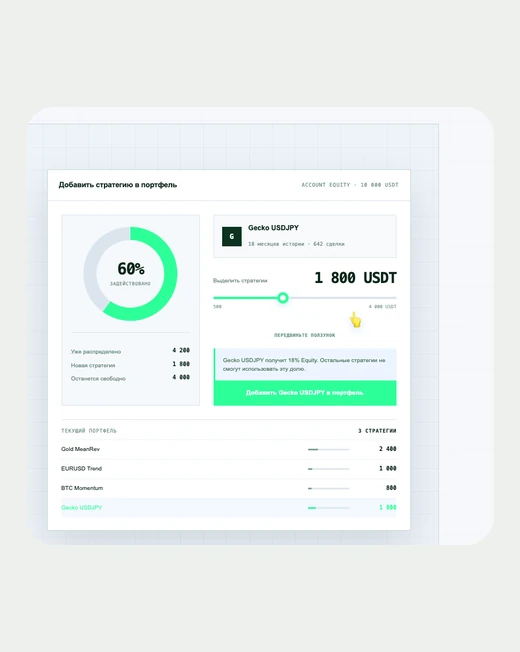
Several strategies on one account require the limit to be divided: it is set on the account as a whole, while the risk of the systems adds up. Allocation is an add-on over MetaTrader 5 that keeps that division: each strategy gets its own budget, its own lot ceiling and its own stop on losses. Below: what it can do and what it cannot.
What Allocation is and what it does to the account
Allocation is neither a terminal nor a prop firm engine but a management layer over a MetaTrader account: by the product's description MT4 and MT5 are supported. That is exactly why it stands as a separate class in the catalogue of environments: it draws no charts and invents no orders of its own, it distributes capital between connected strategies and holds the limits you set. The connection has rights to read and trade only: the platform cannot withdraw money. Each connected strategy is assigned a share of capital, and separately a lot ceiling per position, a size multiplier and a stop on floating losses.
The analytics answer the question about the source of a drawdown: the result is broken down by instrument, hour of day, day of week and month, and in the trade log the source price sits next to your fill price — so slippage is visible. On a prop account that is more useful than a returns chart: accounts are closed for drawdown, not for low returns.
Why risk adds up while the limit does not grow
The daily limit is set on the account, not on a strategy. Two systems at 1.25% risk per trade are not 1.25% but 2.5% at the moment both are in the market. And if they are correlated as well — trading major pairs in the same direction — the drawdown arrives as one blow rather than two.
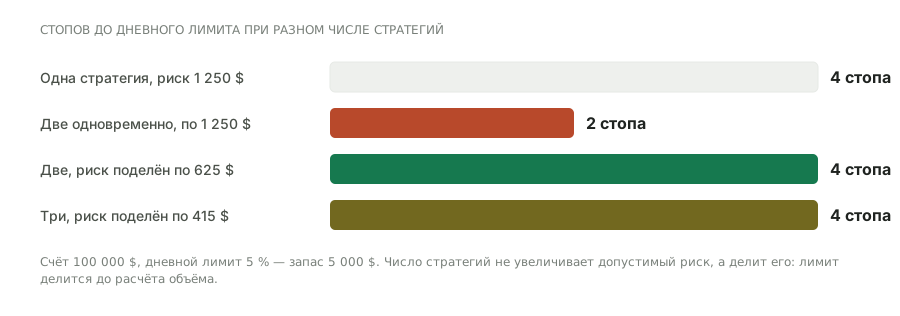
The numbers are simple. With a 5% daily limit on a $100,000 account the cushion is $5,000. One strategy risking $1,250 per trade survives four stops. Two such strategies running at once survive two. Neither of them knows it: each counts its own risk separately.
| How many strategies | Risk per trade of each | Stops to the daily limit |
|---|---|---|
| one | $1,250 | 4 |
| two at once | $1,250 | 2 |
| two, but at $625 | $625 | 4 |
| three, but at $415 | $415 | 4 |
The conclusion that saves accounts. The number of strategies does not increase the risk you may take — it divides it. The daily limit is divided by the number of systems running at once before each one's size is worked out, not after.
A portfolio of strategies on a prop account: what an add-on has to do
Dividing the budget by hand is possible, but with several systems it stops working: sizes are recomputed every time and the floating loss is visible only in the terminal. Hence this class of tool — a management layer between the strategies and the account; the question of how to divide risk between strategies it answers with settings rather than with discipline.
The share of capital within which a strategy operates. Not a separate sub-account: the positions are still on one account and under the same rules.
the basisAn upper bound on size per position. It cuts off the case where an algorithm, after a settings error, places a size several times the calculated one.
the safety netA threshold beyond which the strategy stops opening anything new. It is the floating loss that breaches the limit when it is measured from equity.
the main thingResults by instrument, hour and day: it shows which system creates the drawdown, not only which is in profit.
for decisionsFrequently asked questions
What does Allocation do to my account?
It divides it between the connected strategies: each is assigned a share of capital, a lot ceiling per position and a stop threshold on floating losses. No separate sub-accounts appear — the positions stay on one account and under the same firm rules.
Can several strategies be traded on a prop account?
The rules usually do not prohibit it: the limit is set on the account, and how you spend it is your business. What is prohibited is something else — several accounts with hedging between them, and that is a separate clause of the rules.
How should the daily limit be divided between strategies?
Divide it before working out size: the limit by the number of systems running at once. With a $5,000 limit and two strategies each works out its size from $2,500 rather than from the full sum.
What if the strategies do not overlap in time?
Then the risk does not add up and the limit need not be divided — but check that in fact rather than in intention. A morning system that held a position over easily meets the afternoon one.
Does diversification help pass a challenge?
Not by itself. Several systems smooth the curve only if they really are independent; on correlated instruments they produce one drawdown, only a larger one.
Why use an add-on if it can be counted by hand?
With one strategy it need not be. With three, counting by hand breaks down: sizes are recomputed for every trade, and the floating loss has to be seen in total and in time.
Can the add-on withdraw money from the account?
With tools of this class the connection usually has no withdrawal rights — check that in the description of the access permissions. The funds stay on your account at the broker or on the prop account.
Does the add-on watch the prop firm's rules?
No, and that is worth understanding in advance. It enforces the limits you set: the budget, the lot ceiling, the stop on losses. About the firm's daily limit and the consistency rule it knows nothing.
What should be done about correlation between strategies?
Look at the breakdown by instrument: if two systems trade the same pairs in the same direction, the total risk is counted as one trade of double the size.
Where should I start if I have several strategies?
With dividing the limit and recomputing each system's size for its own share. Until that is done, any add-on will merely enforce too much risk very neatly.
Read next
