 PPTF
PPTFA prop firm web terminal: built in-house
A prop firm web terminal is the fourth option alongside MetaTrader, the engines and external charts. We work out why firms write the interface themselves, what it gives the trader and what it costs.
A prop firm's own platform: why they write it
A ready-made bundle costs money and imposes limits: the feature set is defined by the vendor. Building in-house removes both — the firm stops paying for a licence and can show exactly its own rules in the interface.
Hence the one genuine advantage for the trader: the rules, the drawdown counter, the count of trading days and the log of breaches sit in the same place as the trades. There is no need to keep a second window and reconcile what the terminal shows with what the firm counts — there is one source.
- Rules and trades in one place
- The limits counter next to the positions, the history of breaches in the same place. Of all the options this is the most coherent interface.
- No licence restrictions
- The firm changes the interface to suit its own terms: it shows what it needs, the way it needs. Ready-made bundles allow no such freedom.
- The quality depends on the firm alone
- Neither a vendor nor an industry standard provides a safety net: a prop company's terminal lives at exactly the level the firm itself has provided. That is also the main risk — there is nothing to compare it with.
What it costs you
Four downsides, and all four come to light after payment if they are not checked in advance.
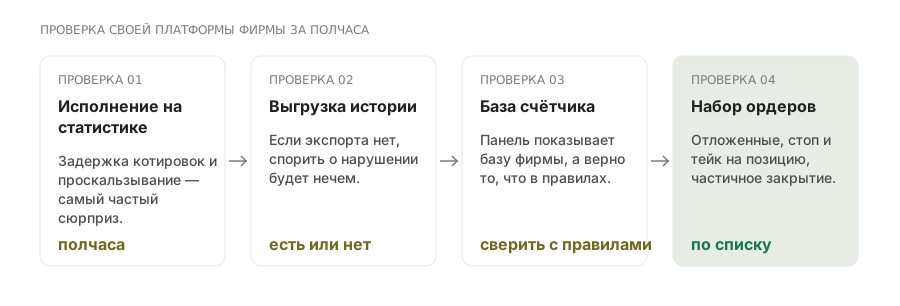
What to check before paying
The check is free: most programmes have demo access, and it is enough to settle all four questions.
Especially at the moment of a data release: a lag in quote updates and slippage on an in-house platform are the most common surprise.
half an hourIf there is no export at all, there will be nothing to argue a breach with. That alone is a reason to choose a different programme.
minutesThe panel shows the base the firm built in. Make sure it matches the text of the rules and not just your expectations.
minutesPending orders, stop and take-profit on a position, partial closes. If your strategy uses any of them, they have to be there.
by the listFrequently asked questions
Why does a prop firm need its own platform?
So as not to pay for a licence and to show its own rules in the interface. For the trader that means a limits counter next to the trades; for the firm, freedom to change the interface to suit its terms.
Is it risky to trade in a firm's own terminal?
In itself no — the rules and the execution are set by the engine in any environment. The risk is elsewhere: there is nothing to compare the platform's quality with, and it can only be tested on a demo account.
Can advisors be used?
Usually not: an in-house platform rarely has an environment for algorithms. Discretionary trading carries over, automated trading does not.
Does markup carry over from MetaTrader?
No. Templates, indicators and saved levels are tied to the terminal rather than to the account. Everything has to be marked up again.
Is there an export of the trade history?
At some programmes there is, at others none at all. It is worth checking before paying: with no export there is nothing to argue a breach with.
What if the platform freezes in the middle of a streak?
First a call or a chat with support and a record of the time, then a complaint. But it is more useful in advance to keep server-side stop orders: they trigger even when the interface is unavailable.
Does the drawdown counter tell the truth?
It shows the base the firm built in. If that diverges from the text of the rules, what the rules say is what counts — and it is worth establishing before you start.
Is execution worse than in MetaTrader?
Not necessarily: execution depends on the liquidity provider rather than on the interface. The difference is that a great deal is known about how MetaTrader behaves, and about a firm's own platform only what you learn in practice.
Can I ask for MetaTrader instead of the in-house platform?
If the programme offers a choice, yes, and it is worth doing with finished code. If there is only one platform, there is no choice: the environment comes with the programme.
Who does such an environment suit?
Someone who trades by hand and values one screen for trades and limits. For anyone with an algorithm or a developed markup it almost never suits.
Read next
