 PPTF
PPTFcTrader on a prop account
cTrader for prop turns up at programmes that bet on transparent execution. We work out what that gives you in practice: market depth, a detailed trade log and algorithms in C# instead of MQL.
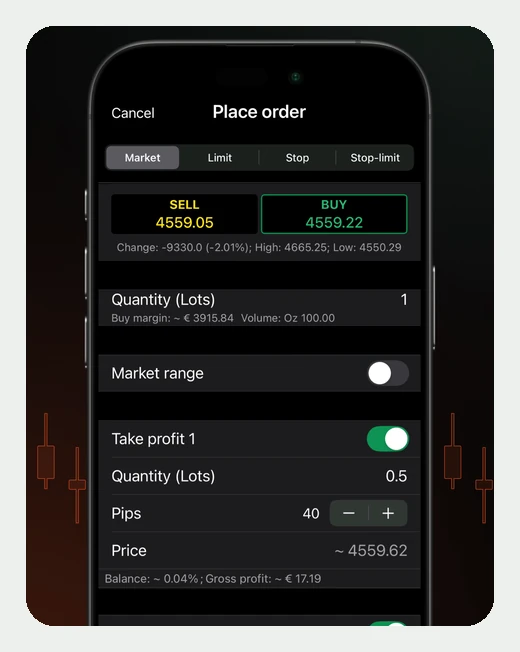
What market depth gives you on a prop account
cTrader shows not a single price but the order book. On a prop account that is useful not for trading off the book but for two specific things.
The first is estimating slippage before the trade. You can see what size sits on the nearest levels and tell whether your lot will fill at the price or sweep several levels. For sizing that is a direct input: on a prop account slippage eats into the cushion up to the daily limit.
The second is reviewing what has already happened. The execution log in cTrader records the requested price and the fill price separately, so an argument with the firm about the price at which a stop triggered is settled from an export rather than from correspondence.
- The order book
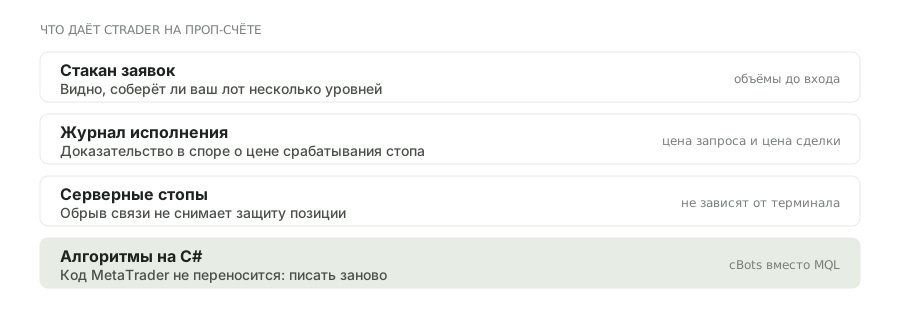
- Sizes on the levels are visible before you enter. It lets you tell in advance whether your lot will sweep several levels and what that will cost.
- A separated log
- The requested price and the fill price are recorded separately. That is the evidence in a dispute over a contested stop.
- Server-side stops
- Stop and take-profit live on the server side: by the platform's documentation they stay active even when the app is closed. The same place holds server-side trailing, break-even moves and up to five take-profit levels.
cBots in prop trading: algorithms in C# instead of MQL
In cTrader automation is written in C# and is called cBots. It is not a variant of MQL but a different platform entirely: different libraries, a different development environment and a different event model.
| Side | MetaTrader | cTrader |
|---|---|---|
| Language | MQL4 or MQL5 | C# |
| Name | advisor, expert | cBot |
| What carries over | between MT4 and MT5 — with a rewrite | from MetaTrader — nothing |
| Indicators | MQL, an enormous library | C#, a smaller library |
Practical conclusion. If your strategy is automated and written for MetaTrader, cTrader means rewriting it from scratch and testing it again. This environment is worth choosing either for discretionary trading or when there is no algorithm yet and it can be written in C# from the start.
What to check in a prop programme on cTrader
Three questions that are asked differently in this environment than in MetaTrader.
Frequently asked questions
Are there prop firms with cTrader?
Yes, and there are more of them each year: the environment comes in infrastructure bundles on a par with web platforms. At some programmes cTrader sits next to MT5 as a second option.
Do MetaTrader advisors work in cTrader?
No. Automation here is written in C# and is called cBots — MQL code does not carry over at all, it has to be written again.
Why does a prop account need market depth?
To estimate slippage in advance. You can see what size sits on the nearest levels and tell whether your lot will sweep several of them — and slippage reduces the cushion up to the daily limit.
How is the execution log useful in a dispute with the firm?
It records the requested price and the fill price separately. If a stop filled worse than stated, that is visible in the export — the burden of proof is on the trader, and a log like this saves a lot of correspondence.
Are cTrader stops stored on the server?
Yes: by the platform's documentation, server-side stop and take-profit stay active even if the app is closed or disconnected. For a prop account that matters more than for your own: a breached limit is not undone by an explanation about your internet.
Can trades be copied inside cTrader?
The platform has built-in copying, but on a prop account what matters is not the technical capability but the firm's rules: copying between accounts is often banned by a separate clause.
Does the spread in cTrader differ from MT5 at the same firm?
It can, because the spread is set by the liquidity provider and the account model, not by the terminal. Compare on the same instrument at the same time.
What is a requote and does it happen here?
A repeat price request at execution. It happens with instant confirmation and does not happen with market execution — the type is stated in the symbol properties.
Is there a mobile version of cTrader?
There is, and it supports the main operations. But the order book and the detailed log are easier to read on a big screen — and they are precisely the reason to choose this environment.
Who does cTrader suit on a prop account, and who does it not?
It suits discretionary trading and people writing algorithms from scratch: execution is more transparent. It does not suit anyone with finished MQL code — a rewrite plus retesting costs more than the difference in convenience.
Read next
